

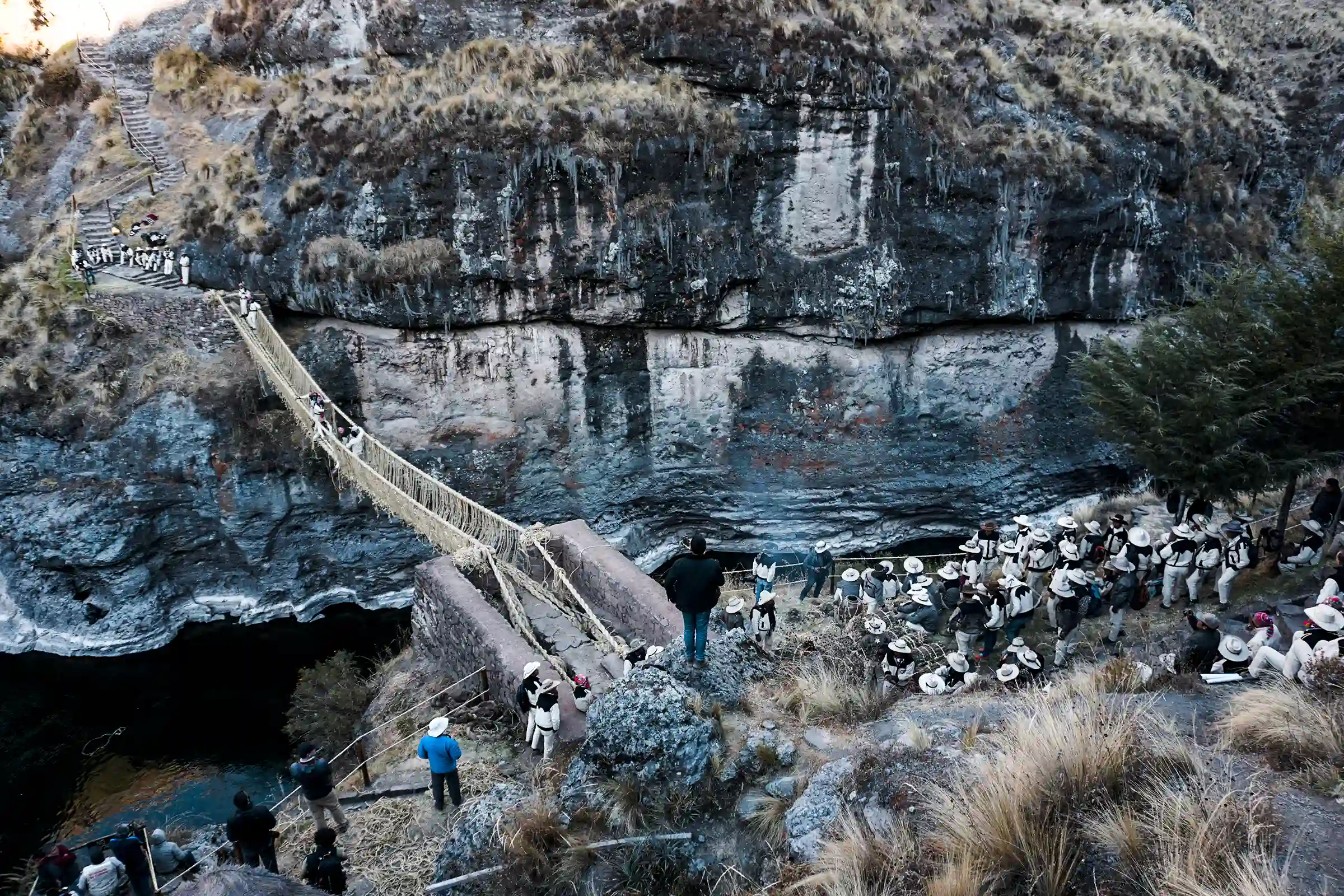
Q’eswachaka Inca Rope Bridge: A Living Legacy of the Inca Empire
-
Introduction: Discover the Last Q’eswachaka Inca Rope Bridge in Peru
The Q’eswachaka Inca Rope Bridge is one of the most fascinating examples of ancient Inca engineering and Andean cultural heritage in Peru. Hidden among the spectacular landscapes of southern Cusco, this extraordinary suspension bridge crosses the Apurímac River and preserves a construction technique that has survived for centuries.
Made entirely from natural plant fibers known as q’oya or ichu grass, Q’eswachaka represents the ingenuity, knowledge, and extraordinary community spirit of the ancient Andean people. Unlike modern bridges made of steel and concrete, this remarkable structure is rebuilt every year by local communities who continue to practice traditional techniques passed down from generation to generation.
Visiting Q’eswachaka is much more than crossing an ancient bridge. It is an opportunity to discover living Inca traditions, admire breathtaking mountain scenery, learn about ancestral engineering, and experience an important part of Peru’s cultural identity.
With HL Transportes Turísticos Cusco, you can discover this extraordinary destination on a private day tour from Cusco, enjoying personalized transportation, flexible stops, and a comfortable journey through the beautiful landscapes of the southern Andes.
-
Where Is the Q’eswachaka Inca Rope Bridge Located?
The Q’eswachaka Inca Rope Bridge is located in the district of Quehue, in the province of Canas, approximately 150 kilometers south of Cusco, Peru. It crosses the Apurímac River, connecting the surrounding mountainous communities.
Situated at approximately 3,700 meters (12,139 feet) above sea level, the bridge is surrounded by rugged mountains, deep river valleys, agricultural landscapes, and traditional Andean settlements.
Its remote location makes the journey particularly rewarding for travelers interested in exploring destinations beyond the traditional tourist circuit of Cusco.
Geographical information:
- Destination: Q’eswachaka Inca Rope Bridge.
- Country: Peru.
- Region: Cusco.
- Province: Canas.
- District: Quehue.
- River: Apurímac River.
- Approximate altitude: 3,700 meters (12,139 feet).
- Distance from Cusco: Approximately 150 km / 93.2 miles.
- Travel time: Approximately 3.5–4.5 hours each way by road, depending on road conditions and stops.
-
History of the Q’eswachaka Inca Rope Bridge
The history of Q’eswachaka dates back to the Inca civilization, when an extensive network of roads known as the Qhapaq Ñan (Inca Trails) connected different territories throughout the vast Inca Empire.
Because the Andes are characterized by deep valleys, rivers, and mountainous terrain, the Incas developed ingenious suspension bridges using natural fibers. These structures allowed people, messengers, soldiers, and goods to travel between communities and administrative centers.
Q’eswachaka is one of the last surviving examples of this traditional bridge-building technology.
Its continued existence is possible thanks to the collective efforts of four local communities: Huinchiri, Chaupibanda, Choccayhua, and Ccollana Quehue. These communities preserve ancestral knowledge and maintain the bridge through an annual reconstruction ceremony.
Today, Q’eswachaka is recognized as an important symbol of Andean identity, cultural continuity, and community cooperation.
In 2013, UNESCO inscribed the traditional knowledge, techniques, and rituals associated with the annual renewal of the Q’eswachaka bridge on its Representative List of the Intangible Cultural Heritage of Humanity.
-
How Is the Q’eswachaka Inca Bridge Made?
One of the most impressive aspects of Q’eswachaka is its construction. The bridge is made entirely from natural fibers, following traditional techniques that have been preserved for generations.
The main material is q’oya, a type of Andean grass commonly associated with ichu. Local families collect, dry, prepare, and twist these fibers to create strong ropes.
The construction process involves several stages:
-
Collecting the natural fibers
Community members gather the necessary grass from the surrounding Andean landscapes. The fibers are prepared to make them suitable for twisting.
-
Preparing the small ropes
Families work together to twist the grass fibers into smaller ropes. These are combined to produce thicker and stronger cables.
-
Creating the main suspension cables
The smaller ropes are joined together to form the large cables that support the bridge. These are carefully secured on both sides of the river.
-
Building the bridge structure
Additional ropes are installed to create the walking surface and protective side railings. The entire structure is assembled using traditional techniques without modern steel cables.
-
Completing the annual renewal
Once the new bridge is finished, the community celebrates the completion of this important cultural tradition with music, food, and ancestral ceremonies.
This extraordinary process demonstrates the engineering knowledge of the Incas and the importance of cooperation in Andean communities.
-
The Annual Q’eswachaka Bridge Renewal Ceremony
One of the most extraordinary cultural events in Cusco takes place every year in June, when the four communities gather to renew the Q’eswachaka Bridge.
This ancestral tradition follows the Andean principle of Minka (also written Mink’a), a form of collective community work in which families cooperate for the benefit of everyone.
The renewal process traditionally takes place over four days:
- First day – Preparation of the grass ropes: Community members prepare the natural fibers and twist them into long ropes. Traditional ceremonies are performed to ask the protection of Pachamama (Mother Earth) and the Apus (sacred mountain spirits).
- Second day – Installation of the main cables: The large grass ropes are secured to the stone foundations on both sides of the river, creating the main structure of the bridge.
- Third day – Weaving the bridge: Skilled bridge builders, known as Chakaruwac or Chakaruwak, weave the walking surface and side ropes using ancestral techniques.
- Fourth day – Celebration: Once the bridge is completed, the participating communities celebrate with traditional music, dances, food, and cultural activities.
The annual renewal is not simply a construction activity. It is a meaningful expression of Andean identity, cooperation, and respect for ancestral knowledge.
In 2013, UNESCO recognized these traditional practices and rituals as Intangible Cultural Heritage of Humanity.
Travel tip: If you want to experience this unique cultural celebration, plan your visit around the first or second week of June. The exact dates and activities should be confirmed with local authorities because the bridge renewal follows a community-organized schedule.
-
What Makes Q’eswachaka Special?
Q’eswachaka is much more than an ancient bridge. It is a living example of how traditional knowledge, engineering, and community cooperation have survived over centuries.
Here are some of the reasons why this destination is so special:
An authentic Inca construction technique: The bridge is made from natural plant fibers using traditional techniques inherited from the Inca period.
A living cultural tradition: Unlike archaeological structures that are preserved as ruins, Q’eswachaka is rebuilt every year by the local communities.
UNESCO recognition: Its annual renewal practices and associated rituals were recognized as Intangible Cultural Heritage of Humanity in 2013.
Spectacular Andean scenery: The bridge crosses the impressive Apurímac River canyon, offering beautiful panoramic views of the surrounding mountains.
A unique cultural experience: Visitors can learn about Andean traditions, local craftsmanship, traditional architecture, and the importance of collective work.
An unforgettable crossing experience: Walking across a suspension bridge made entirely from woven grass is an extraordinary experience for adventurous travelers.
-
What Can You See and Do at Q’eswachaka?
A visit to Q’eswachaka offers several opportunities to discover the cultural and natural attractions of the area.
Walk Across the Last Inca Rope Bridge
The highlight of the visit is crossing the suspension bridge. Feel its gentle movement as you walk over the Apurímac River, surrounded by the spectacular scenery of the Andean canyon.
The bridge is approximately 28 meters long and 1.20 meters wide. Its narrow structure and natural grass construction make the crossing a memorable experience.
Always follow the instructions of your guide and local authorities. Walk slowly, hold the side ropes, and avoid sudden movements. Do not cross if access is restricted or the structure is undergoing maintenance.
Admire the Apurímac River Canyon
From the surrounding viewpoints, admire the impressive canyon formed by the Apurímac River. Its deep valley, rocky formations, and mountainous landscapes create excellent opportunities for photography.
Discover Traditional Andean Culture
Learn how local families preserve ancestral knowledge through the preparation and weaving of natural fibers. During the annual renewal, visitors may have the opportunity to observe different stages of this traditional process, depending on the schedule and access arrangements.
Enjoy Photography and Nature
The bridge, river canyon, surrounding mountains, and traditional communities provide beautiful scenery for landscape and travel photography.
-
The Best Time to Visit Q’eswachaka
Q’eswachaka can be visited throughout the year, but weather conditions can influence the comfort of your journey and the road conditions.
The most recommended period is generally from May to October, during the dry season in the Cusco region.
- Dry season: May – October. More sunny days, clearer mountain views, and generally favorable road conditions.
- Rainy season: November – April. More frequent rainfall, cloudy skies, and potentially difficult road conditions.
- Bridge renewal: Opportunity to experience the annual cultural tradition
May to October: These months are particularly suitable for travelers who want to enjoy the scenery, take photographs, and cross the bridge under generally drier conditions.
June: This is a particularly interesting month because of the annual bridge renewal ceremony. Travelers interested in Andean culture may have an opportunity to witness this extraordinary tradition.
November to April: The destination remains interesting, but rain can affect the journey. Travelers should be prepared for changing weather and possible road delays.
Keep in mind that weather conditions in the Andes can change quickly, regardless of the season.
-
How to Get to Q’eswachaka from Cusco
Q’eswachaka is approximately 150 kilometers / 93.2 miles from Cusco and can be reached by private vehicle or organized tour.
The journey takes approximately 3.5 to 4.5 hours each way, depending on traffic, weather, road conditions, and sightseeing stops.
The route travels through the southern Andes of Cusco, offering beautiful mountain scenery, traditional villages, agricultural landscapes, and opportunities to discover lesser-known destinations.
Recommended route for a private day tour
A private Q’eswachaka tour can include the following itinerary:
- Cusco: Departure from your hotel in a private vehicle.
- Southern Valley of Cusco: Enjoy the Andean countryside and traditional villages along the route.
- Four Lagoons Circuit (optional): Depending on the itinerary, visit scenic lagoons such as Pomacanchi, Acopia, Asnacocha, and Pampamarca (Tungasuca).
- Q’eswachaka Bridge: Arrive in Quehue, explore the surroundings, admire the Apurímac River canyon, and experience the traditional Inca rope bridge.
- Return to Cusco: Enjoy the scenic drive back to your hotel.
The Four Lagoons Circuit is an excellent optional addition for travelers who want to explore more of the southern Cusco region. Its inclusion depends on the available time and the selected tour itinerary.
-
Why Visit Q’eswachaka with HL Transportes Turísticos Cusco?
Discover the extraordinary Q’eswachaka Inca Rope Bridge with the comfort and personalized attention of HL Transportes Turísticos Cusco.
Our private transportation service is designed for travelers who want to explore the cultural and natural attractions of southern Cusco at their own pace.
Whether you are interested in ancient Inca engineering, traditional Andean culture, spectacular landscapes, or unique photographic opportunities, a private tour offers a comfortable and flexible way to discover this remarkable destination.
Why choose our private Q’eswachaka tour?
- Private transportation exclusively for your group.
- Hotel pickup and drop-off in Cusco.
- Flexible departure times and personalized itineraries.
- Comfortable vehicles suitable for long-distance journeys.
- Optional stops at scenic viewpoints and the Four Lagoons Circuit.
- Personalized attention throughout the journey.
- Opportunity to explore destinations beyond the traditional Cusco tourist circuit.
Experience the living legacy of the Incas with HL Transportes Turísticos Cusco. Let us take you on a memorable journey to one of Peru’s most extraordinary cultural treasures.
Contact HL Transportes Turísticos to organize your private Q’eswachaka day tour.
-
Practical Recommendations for Visiting Q’eswachaka
To enjoy your visit safely and comfortably, consider the following recommendations:
- Acclimatize to the altitude: Spend at least one or two days in Cusco before undertaking this excursion, especially if you are arriving from a low-altitude destination.
- Wear comfortable walking shoes: Choose hiking shoes or sneakers with good grip.
- Bring warm clothing: Temperatures can be cold, particularly during early morning and late afternoon.
- Use sunscreen: The high-altitude sun can be strong, even when temperatures are low.
- Bring water and snacks: Stay hydrated throughout the journey.
- Carry cash: Small communities and local establishments may have limited card payment facilities.
- Respect local traditions: Ask permission before photographing local people, ceremonies, or community activities.
- Follow bridge safety instructions: Cross slowly, hold the side ropes, and follow your guide’s recommendations.
- Bring a camera: The Apurímac River canyon and surrounding Andean landscapes offer wonderful photography opportunities.
- Check road and bridge conditions: Confirm accessibility before departure, particularly during the rainy season or annual reconstruction.
-
Frequently Asked Questions About Q’eswachaka Inca Rope Bridge
-
Where is the Q’eswachaka Inca Rope Bridge located?
The Q’eswachaka Bridge is located in the district of Quehue, province of Canas, approximately 150 kilometers / 93.2 miles south of Cusco, Peru. It crosses the Apurímac River and connects two sides of an impressive Andean canyon.
-
How high is the Q’eswachaka Bridge above sea level?
The bridge is located at approximately 3,634 meters (11,923 feet) above sea level, according to Peru’s official tourism inventory. It is commonly described as being around 3,700 meters (12,139 feet) above sea level.
-
Why is Q’eswachaka considered the last Inca rope bridge?
Q’eswachaka is considered the last surviving traditional Inca-style suspension bridge made entirely from natural plant fibers, using ancestral construction techniques that continue to be practiced by local communities.
-
How long is the Q’eswachaka Inca Rope Bridge?
The bridge measures approximately 28 meters long and 1.20 meters wide. It is constructed using braided natural grass fibers and traditional suspension techniques.
-
Why is Q’eswachaka recognized by UNESCO?
UNESCO recognized the traditional knowledge, skills, and rituals associated with the annual renewal of Q’eswachaka as Intangible Cultural Heritage of Humanity in 2013. This recognition highlights the importance of preserving Andean cultural traditions and community cooperation.
-
When is the Q’eswachaka Bridge renewed?
The bridge is traditionally renewed every year in June, usually during the first or second week. The process involves four local Quechua communities: Huinchiri, Chaupibanda, Choccayhua, and Ccollana Quehue.
-
How long does it take to travel from Cusco to Q’eswachaka?
The journey takes approximately 3.5 to 4.5 hours each way by private vehicle, depending on road conditions, traffic, and sightseeing stops.
-
Can tourists walk across the Q’eswachaka Inca Bridge?
Yes, visitors can generally walk across the bridge when it is open to the public. However, crossing is subject to local safety regulations, maintenance work, and community restrictions. Visitors must follow the instructions of local authorities and their guides.
-
What is the best time of year to visit Q’eswachaka?
The dry season, from May to October, is generally the best time to visit because of more favorable weather and road conditions. June is particularly interesting for travelers who want to experience the annual bridge renewal ceremony.
-
Is it possible to visit Q’eswachaka on a private day tour from Cusco?
Yes. Q’eswachaka can be visited on a private full-day tour from Cusco. With HL Transportes Turísticos Cusco, travelers can enjoy private transportation, personalized departure times, and optional stops at the Four Lagoons Circuit and other scenic viewpoints along the route.